How you can flip the script, prove compliance, and promote sustainability
When we talk about the environmental impact of AI and data centers, electricity and water consumption tend to dominate the conversation. But there is another part of the equation that deserves just as much attention: What happens to the technology itself?
Every server, storage system and piece of network equipment has a physical lifecycle, beginning with the materials required to manufacture it and continuing through years of use, retirement, reuse, and eventual materials recovery.
As AI infrastructure expands, enterprises must pay closer attention to how they manage technology throughout its lifecycle.
Recent reporting points to growing demand for materials such as copper and aluminum as data center development accelerates, connecting the circularity conversation with increasingly important questions around material security and resilient supply chains.
The U.S. Department of Energy is examining opportunities to increase recovery of critical materials including lithium, cobalt, nickel, copper, and rare earth elements from discarded electronics and return those resources to industrial supply chains.
This raises a bigger question than whether retired equipment was simply recycled:
Do you know what happens to your technology after it leaves your organization? And can you prove it?
As governments and industry focus more attention on critical materials recovery, your IT, Risk and Compliance teams also need to understand how long technology can remain productive, which assets can be reused, which materials can be recovered, how providers manage environmental and compliance risks, and what evidence demonstrates the outcome.
Environmental Responsibility Also Means Managing Risk
When retired technology leaves your data center, your responsibility for what happens next doesn't necessarily end.
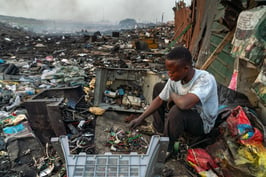 Electronics can contain batteries and other hazardous or toxic materials such as cadmium, chromium, lead, mercury, and lithium requiring specialized handling. Improper processing can contaminate air, soil, and water and expose your organization to regulatory scrutiny and reputational risk.
That makes downstream accountability an important part of environmental responsibility.
A server leaving your facility does not make the associated responsibility disappear. You need confidence that equipment and materials continue through appropriate disposition pathways after they leave your direct control.
The good news? You do not need to manage every one of those pathways yourself.
A qualified IT asset disposition (ITAD) provider manages that responsibility by maintaining the processes, certified downstream relationships, controls, and documentation needed to oversee assets through final disposition.
Keeping Technology in Use Longer
The opportunity to reduce environmental impact starts well before an asset reaches retirement.
That's why we developed Reuse First®, a processing approach that extends the productive life of technology whenever secure and practical. We prioritize redeployment, refurbishment, repair, resale, and other productive uses, reserving recycling for assets that can no longer be reused.
Why does that matter?
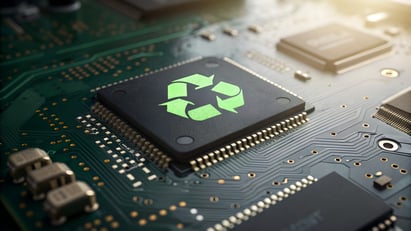 Keeping functional technology in use longer preserves more of the value already invested in the equipment, including the materials, energy and manufacturing required to produce it, while delaying the need to replace that asset with newly manufactured technology.
As you face greater accountability, we help you reduce risk with expert technology management, secure processes, and clear oversight.
Recovering Materials That Still Have Value
Today’s technology contains a mix of metals, plastics, batteries, circuit boards, and other materials, each requiring a different approach to recovery. Some need specialized handling, while others contain valuable commodities, precious metals, and critical materials that can be recovered and returned to manufacturing supply chains.
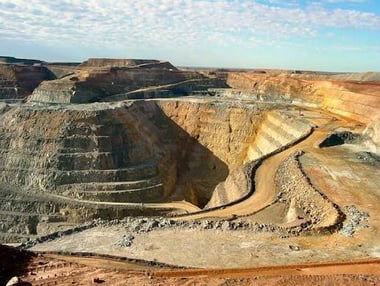 Recovery serves another important sustainability purpose: reducing reliance on virgin resources.
As AI and data center infrastructure increase demand for copper, cobalt, gallium, rare earth elements, and other materials, keeping existing resources in circulation becomes increasingly valuable. By recovering valuable materials from retired technology, your organization can reduce industry demand for newly extracted resources and support a more circular technology supply chain.
Circularity is not simply about repurposing more. It is about recovering the greatest possible value at every stage of an asset’s life. The goal is to preserve the value of the technology first, then preserve the value of its materials when the asset can no longer be used.
R2v3 Appendix E certification further supports that approach through audited materials-recovery processes focused on responsible material management and circular-economy outcomes. At DMD, we hold the highest R2v3 certifications from SERI, not for bragging rights, but to govern processing and ensure responsible management of our clients’ assets.
Measure the Impact, Then Show the Proof
You’ll need more than environmental claims. You need measurable results you can use to evaluate performance and substantiate your sustainability reporting.
As an example, our 2025 Impact Report demonstrates the scale of outcomes, and the level of detail that will be needed for compliance:
- 155,042,470 kWh in energy savings
- 2,611,992 kg in primary material savings
- 7,470,769 kg CO2e in GHG emissions savings
- 478,379,000 kg in air emissions savings
- 1,255,000 kg in water emissions savings
- 1,226 kg in toxic material savings
These 2025 figures are calculated using the EPA’s Electronics Environmental Benefits Calculator (EEBC) methodology documented in our environmental reporting.
Measure the outcome. Manage the risk. Document the process. Provide the proof.
Environmental reporting should do more than summarize sustainability claims. It should give you visibility into what happened to your retired technology and provide measurable information you can use to prove outcomes.
For example, the DMD Passport® Portal gives you access to sustainability reporting that tracks reuse and recycling activity so that you have visibility into your risk and compliance exposure.
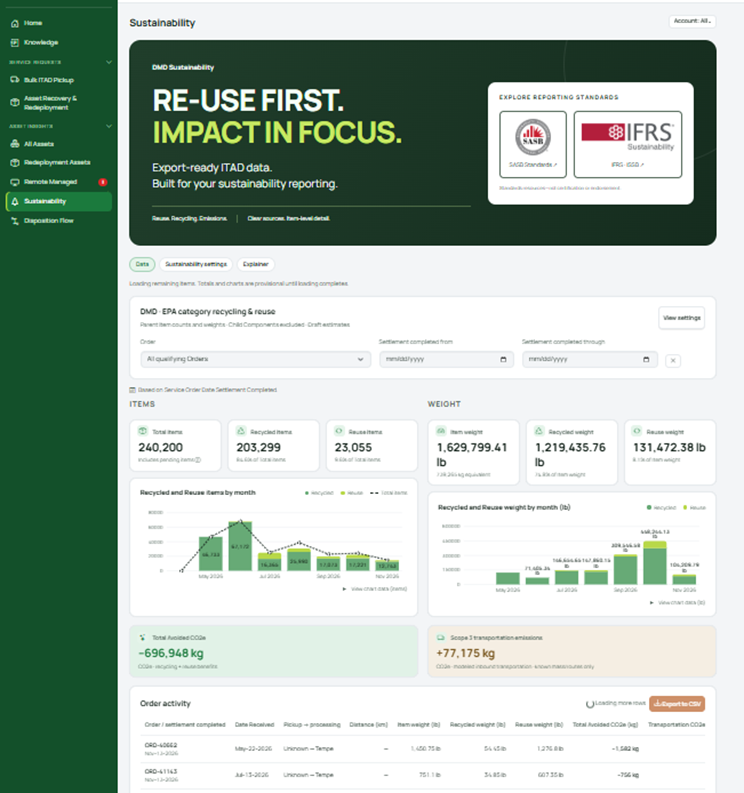
DMD Passport® connects those environmental outcomes to the underlying asset disposition process. Reporting provides visibility into reuse and recycling activity, material weights, and estimated avoided emissions. Certified Data Security Reporting and Certificates of Destruction add important documentation for data security, risk, and compliance.
Together, these records provide more than a sustainability summary. They create a documented trail of what happened to retired technology and the evidence needed to support environmental, security, and compliance reporting.
Your Part in a Much Bigger Goal
For us, sustainability isn’t a response to AI or the latest environmental conversation. Environmental responsibility has always been at the heart of what we do and why we do it.
- Our Mission: DMD protects our environment one IT asset at a time.
- Our Vision: Every IT asset is put to its next best use.
- Our Ambition: By 2030, DMD will put 5 million items annually to their next best use.
That ambition matters because environmental progress at this scale is cumulative.
 Every asset that remains in productive use longer matters.
Every asset that finds another productive life matters.
Every kilogram of material that can be recovered rather than replaced with virgin material matters.
And every device that moves through a controlled, documented, and responsible disposition process contributes to a larger outcome.
We are building the capabilities, processes, and accountability to do that work. But reaching that ambition also requires your participation.
Demand clear answers:
- Know what was reused and kept in productive use.
- Know what was recycled and what materials were recovered.
- Know how environmental and compliance risks were managed.
- Know what impact was achieved.
- And have the reporting and documentation to prove it.
Our ambition is to put 5 million items annually to their next best use. Getting there takes partnerships with organizations like yours. You provide the opportunity, and we’ll put the process, expertise, and accountability behind it.


COMMENTS